
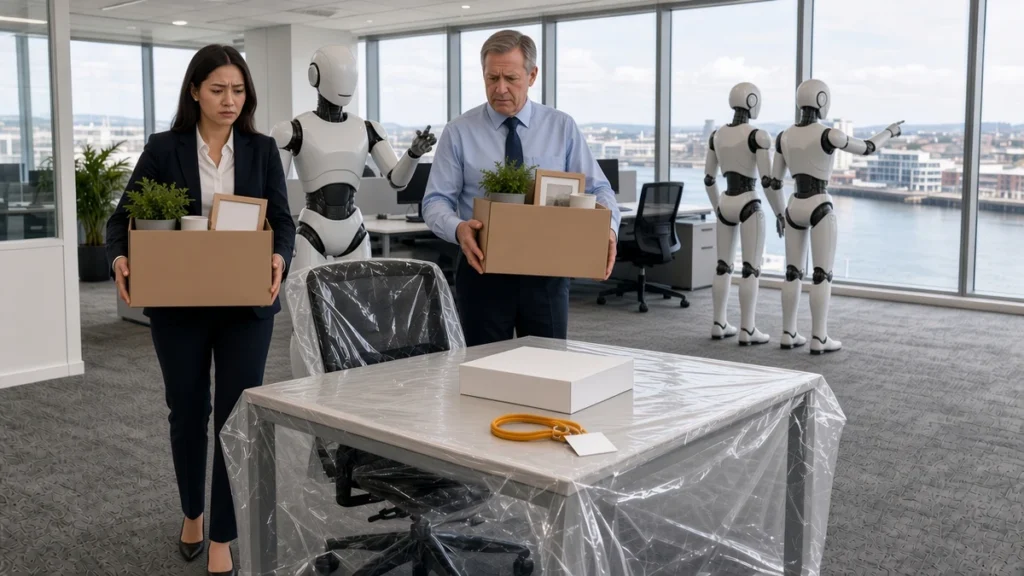
Ask commentators where AI is taking jobs and you get two competing stories. One camp says new entrants are hit hardest as firms freeze junior hiring. The other claims older workers are being pushed out because younger recruits are quicker with new tools. We tested both claims against the latest evidence. On age, the verdict is clear. On AI, it is not.
Young people are losing out

From June to August 2026, UK unemployment for 16 to 24-year-olds hit 15.6%, up from 14.6% a year earlier (House of Commons Library, ONS data). For 50 to 64-year-olds, it fell from 3.2% to 2.7% (ONS). UK youth unemployment is now nearly six times the rate for 50 to 64-year-olds.
Payroll records tell the same story. Between December 2022 and December 2025, the share of 16 to 24-year-olds in payrolled jobs fell by 4.3 percentage points, from 54.9% to 50.6%, roughly 330,000 people (IFS).
On 28 October, the Low Pay Commission noted that “youth unemployment remains above its covid peak and at rates last seen in 2015”, whereas adult unemployment “peaked at the end of 2025 and fell over the first half of 2026” (Low Pay Commission).
UK youth unemployment is now nearly six times the rate for 50 to 64-year-olds.
US data point the same way. Tracking millions of payroll records, Stanford’s Digital Economy Lab found in August that 22 to 25-year-olds in the most AI-exposed roles are 19% below where they would be had they kept pace with peers in less exposed jobs (Stanford Digital Economy Lab). “Experienced workers show no comparable gap,” the authors note.
A hiring freeze, not a wave of sackings

Young people are not being fired. They are simply not being hired.
Stanford found the employment gap works “primarily through reduced hiring of young workers rather than increased separations” (Stanford Digital Economy Lab). UK figures match that pattern. Vacancies dropped to 691,000 in July to September 2026, the lowest level since 2014 outside the pandemic (ONS). Meanwhile, redundancies remain flat at 3.8 per 1,000 employees across all ages, unchanged from a year earlier (ONS). The Low Pay Commission calls this a “low hire, low fire” market.
Young people are not being fired. They are simply not being hired.
Commentator Wolfgang Münchau offered this explanation on UnHerd’s Econoclasts show on 30 October (UnHerd, about 01:08), though he cited no data for it: “AI is not replacing jobs in the sense that companies fire people in order to replace them with AI. […] If companies, industry-wide, start hiring freezes, they start with young people because the people on their first jobs are young, people on their last jobs are old, so we have this disproportionate impact on young people.”
The case that older workers are losing out

The rival camp argues that workers in their fifties and sixties are paying the price.
Salim Ismail, founder of Open ExO, made this claim on the Moonshots podcast on 28 October (Moonshots #306, about 05:50). Asked whether firms were expanding graduate schemes, he said: “Not necessarily. We’re seeing some weird things. For example, a bunch of people are increasing graduate hiring because young people armed with AI are much more valuable than 50-year-olds moving spreadsheets around. And so some companies are actually increasing and replacing older workers aggressively and have increased graduate programs because they’re just so much more AI native. But generally, it’s a problem.”
Ismail offers no company names or figures for this claim, and qualifies it himself.
Parts of the wider evidence do touch on his argument, but miss his conclusion:
- AI use matters more than age: Gallup found that 62% of laid-off US workers use AI once a year or less, compared with 50% of those still in work (Gallup). This “holds even after accounting for age, education, type of industry”. This suggests, in our view, that low AI use matters more than age, though the survey shows a link, not a cause.
- Older inactivity isn’t driven by AI: The Centre for Ageing Better notes that 21% of people aged 50 to state pension age, 2.9 million people in 2025, are not in employment, education, training or retirement (Centre for Ageing Better). However, that figure includes those out of work due to ill health or caring responsibilities, and the charity does not link it to AI.
- Graduate hiring is mixed: Among 155 large employers surveyed by the Institute of Student Employers, “45% increased their graduate intake, 15% maintained it and 40% made reductions” (ISE). We found no evidence that firms expanding graduate schemes are cutting older staff to do so.
Is AI really the cause?

Who is losing out is clear. Why is much harder to prove.
Even the Stanford authors urge caution, noting their estimates are “more sensitive to specification choices”, raising “legitimate questions both about how much of the pattern is actually caused by AI” (Stanford Digital Economy Lab). Four other explanations carry real weight.
Weak hiring across the board. Just 57% of private sector employers plan to recruit, a joint record low outside the pandemic (CIPD). In August, UK job adverts on Indeed sat 32% below pre-pandemic levels, whereas US and euro-area listings were at or above them (Indeed Hiring Lab). A hiring slump that hits the UK harder than its peers is difficult to pin on a global technology.
Labour costs. Smaller firms tell the ONS they may not be recruiting because of increased labour costs (ONS). However, the Low Pay Commission finds that while employment has deteriorated among younger workers, “the evidence does not suggest this is a result of minimum wage increases”, and the IFS notes that youth employment began falling in late 2022, well before employer National Insurance rose.
A hiring slump that hits the UK harder than its peers is difficult to pin on a global technology.
Sector mix. Vacancies have fallen sharpest in “the youth-friendly sectors of retail and hospitality” (Low Pay Commission), hardly the roles most exposed to AI.
Remote work. In the US, New York Fed economists estimate that “remote work can explain 64 percent of the recent increase in unemployment among young college graduates” (Liberty Street Economics).
As the IFS notes, “structural changes may be specifically affecting young people, perhaps including the rise of AI or worsening youth mental health” (IFS). No study can yet untangle AI from everything else.
The picture in the UK and Wales

UK data do not show older workers being pushed out. From June to August 2026, the redundancy rate for over-50s fell by almost a quarter on the year, dropping from 4.7 to 3.6 per 1,000 employees (ONS). Employment for 50 to 64-year-olds edged up from 71.8% to 72.3% (ONS), though the ONS notes these estimates are volatile.
One shift is worth watching: redundancies among 35 to 49-year-olds rose from 3.4 to 4.7 per 1,000 over the same period (ONS). That band includes workers in their late forties, though nothing in the data ties the rise to AI.
In Wales, the squeeze on the young is clearest in the claimant count, a full headcount rather than a sample survey. In September 2026, 15,370 people aged 18 to 24 in Wales claimed unemployment-related benefits. That is up 14.5% on a year earlier, outpacing the 10.6% UK rise and marking the fastest increase of any age group in Wales (our calculation from ONS claimant count data), though the count also shifts with benefit rules.
In Wales, the claimant count for 18 to 24-year-olds rose 14.5% in a year, the fastest rise of any age group.
Survey data are less certain because Welsh age-band samples are small. In the year to June 2026, Welsh unemployment for 16 to 24-year-olds stood at 12.3%, compared with 14.0% across the UK, a gap within the margin of error (our calculation from ONS Annual Population Survey data). For 50 to 64-year-olds, unemployment was just 1.7%, though economic inactivity was much higher: 31.1% were neither working nor looking for work, against 25.7% across the UK. Meanwhile, 14.6% of 16 to 24-year-olds in Wales were not in education, employment or training (NEET) in the year to June 2026, down 0.5 percentage points, though the Welsh Government warns these survey estimates “have become increasingly volatile”.
No Welsh data link any of these trends to AI.
What it means for Wales

Our view: Wales should fix the first rung of the ladder, whatever the cause.
The labour market squeeze is hitting people at the very start of their working lives. Regardless of whether AI, costs, or weak demand are to blame, young people are losing early career experience they cannot easily recover. Three practical responses stand out.
Keep entry-level routes open. In England, where apprenticeships are funded via the levy, the Resolution Foundation found that “just under 70 per cent of higher-level, levy-funded starts over the past decade were taken by people aged 25 and over” (Resolution Foundation). Welsh apprenticeship funding should ringfence places for school and college leavers, and publish uptake by age.
AI may yet reshape entry-level work. Wales must make sure it remains a ladder young people can still climb.
Teach AI skills at every age. Gallup finds that, even after accounting for age, US workers who do not use AI “appear to have been more vulnerable in the job market”. Meanwhile, an employers’ report from the CBI and Oliver Wyman warns that retraining support is “weakest of all for later-career workers and those approaching retirement” (CBI). Practical AI training for school leavers and for over-50s who want to stay in work belong in the same skills plan.
Measure it properly. No official UK or Welsh statistics link job losses to AI, and we found no published breakdown of Welsh redundancies by age. Policymakers need both to know whether they are fighting technological disruption, high costs, or weak demand.
AI may yet reshape entry-level work. Wales must make sure it remains a ladder young people can still climb.