
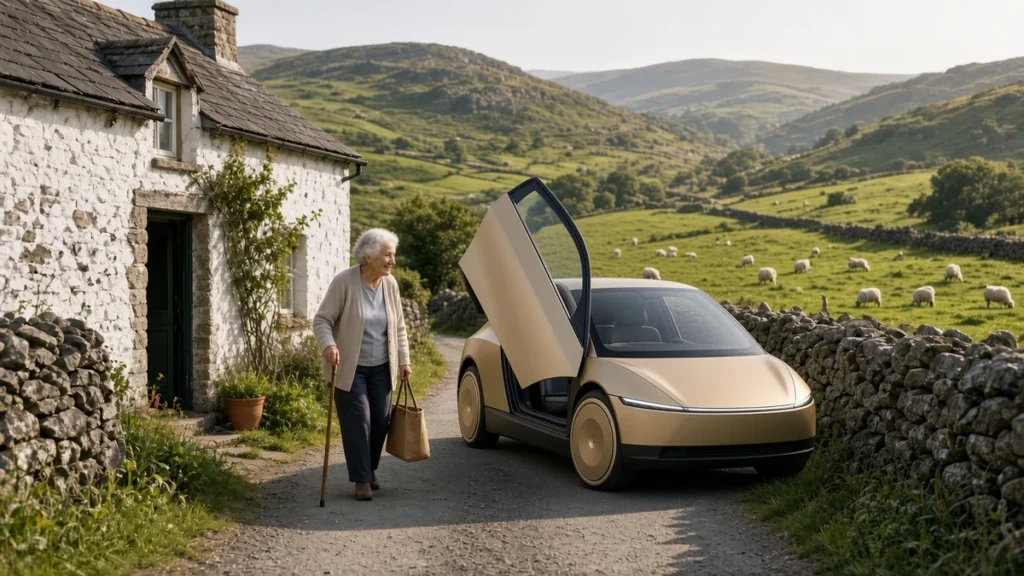
In 2025, 1,538 people were killed on Great Britain’s roads, and 29,918 were killed or seriously injured (DfT, Reported road casualties GB 2025). In Wales alone, 91 people died, up from 84 the year before (Welsh Government, Police recorded road collisions 2025).
When police record what caused a serious crash, the reasons are mostly human: failing to look properly, going too fast, distraction or impairment (DfT, road safety factors 2025). Self-driving cars are built to remove many of those failings. They are now carrying paying passengers in several American cities, and services or trials with a trained safety operator on board have started in London and in several European countries, including Germany (MOIA, July 2026), Luxembourg (RTL Today, 2026) and Croatia, where a paid public service began in Zagreb in April 2026 (Verne, April 2026, background).
1. The safety record: machines against people
Waymo
Waymo operates driverless taxis with no one in the driving seat. By June 2026, its vehicles had logged 271.3 million rider-only miles across Phoenix, San Francisco, Los Angeles, Austin and Atlanta (Waymo Safety Impact).
Waymo reports 95% fewer crashes causing serious injury or worse than human drivers on the same kinds of roads. Its rate was 0.01 such crashes per million miles, against a human benchmark of 0.21. It reports 82% fewer crashes with any injury (0.67 against 3.77 per million miles) and 82% fewer crashes where an airbag went off (Waymo Safety Impact).
Crucially, the biggest safety gains protect people outside the car:
- Pedestrians: 93% fewer injury crashes.
- Cyclists: 86% fewer.
- Motorcyclists: 82% fewer.
That matters enormously in Britain, where pedestrians, cyclists and motorcyclists make up a disproportionately high share of those killed or seriously injured (DfT).
Waymo reports 95% fewer crashes causing serious injury or worse than human drivers on the same kinds of roads.
These figures come with caveats. They are company data, and while the method has been peer reviewed, the study’s authors work for Waymo (Kusano et al., Traffic Injury Prevention, 2025, background). The miles were driven on largely snow-free city streets rather than motorways, the data do not assign fault, and total mileage is still too low to measure deaths directly. For the any-injury figure, Waymo raises the human benchmark to allow for crashes that people never report to police; the serious-injury and airbag figures are not adjusted.
Tesla
Tesla’s Full Self-Driving (Supervised) is a different category of technology. It is a driver-assistance system: the car steers, brakes and accelerates, but a human must watch the road, be ready to take over at any moment and remain legally responsible. Tesla says customers had driven more than 17 billion miles using the system by 4 November 2026 (Tesla, FSD safety).
According to Tesla’s North American data, cars using FSD (Supervised) drove roughly 6.0 million miles between major collisions, compared with 2.0 million miles for manually driven Teslas with active safety features switched on and 660,000 miles for Tesla’s estimated US average (Tesla, safety report). Tesla’s headline claim compares FSD (Supervised) with its own estimate of the US average: “9x” fewer major collisions, “7x” fewer minor collisions and “6x” fewer off-highway collisions. In our view, the fairer comparison is within Tesla’s own fleet, where FSD (Supervised) had roughly three times fewer major collisions than manually driven Teslas.
Like Waymo’s figures, these are company data, read on Tesla’s page on 4 November 2026. On Tesla’s UK site the report is titled Tesla Assisted Driving Vehicle Safety Report (Tesla UK), the name the Dutch regulator, RDW, approved on 3 November 2026 (see section 5). Tesla’s figures are neither independently audited nor peer reviewed. Several factors complicate the picture:
- A collision counts as “major” if an airbag or other restraint deploys, and counts under FSD if the system was active at any point in the prior five seconds.
- The data cover a rolling 12 months in North America, with China excluded. They do not attribute fault, and they rely on Tesla’s own estimate of the US average, partly built from ratios in its own fleet.
- Because a human is supervising, driver intervention may prevent many crashes, and FSD miles may be easier ones.
Tesla claims FSD could save more than 32,000 lives a year in the US. Its footnote says that figure applies its collision reductions to all 2024 US driving and assumes fewer crashes mean fewer deaths. That is Tesla’s extrapolation, not an observed result.
The human baseline
In Great Britain, there were 4 deaths for every billion vehicle miles driven in 2025 (DfT).
It is often claimed that “94% of crashes are caused by human error”. In reality, the US study behind that statistic found only that the final link in the chain of events was assigned to the driver in about 94% of crashes, explicitly “without suggesting that any of these was cause of the crash” (NHTSA, 2018, background). The exact share of crashes a machine could prevent remains unknown.
2. Failures, and how fleets fix them

Self-driving cars do make mistakes, including around school buses.
In October 2025, the US road safety regulator, NHTSA, opened an investigation after Waymo vehicles passed stopped school buses (NHTSA PE25013, background). By December 2025, Waymo had recalled 3,067 vehicles to update their software (NHTSA recall 25E-084, background). A further incident in Austin in January 2026 remains under investigation by the US National Transportation Safety Board; its early findings say a remote assistance worker mistakenly told the car the bus’s warning signals were not active (NTSB HWY26FH007).
When a human driver makes a mistake, one driver might learn from it.
Tesla’s system is also under scrutiny. In October 2025, NHTSA opened a probe into FSD and traffic law breaches, such as running red lights, covering 2,882,566 vehicles (NHTSA PE25012, background).
We think these incidents also show a real advantage of automation. When a human driver makes a mistake, one driver might learn from it. When a self-driving car makes a mistake, engineers can find the cause and send a software fix to the whole fleet. That is what happened with the Waymo recall. For that loop to work, however, regulators must have access to the data, the power to demand fixes and the capacity to check that they work.
3. The moral case: how many lives?

No one knows the exact number of lives self-driving cars would save in Britain, but we can build a transparent estimate of our own by multiplying four variables:
- Current road deaths: 1,538 in Great Britain and 91 in Wales in 2025.
- Share of miles driven autonomously: we test 10%, 25% and 50%.
- Safety improvement: we test 30%, 66% and 90% fewer deaths per mile. Our central 66% matches Tesla’s own figure for FSD (Supervised) against manually driven Teslas with active safety features, and sits below Waymo’s 82% reduction in injury crashes, to allow for tougher British roads.
- UK transferability: we test 70%, 80% and 90%, discounting the benefit for rural lanes, worse weather and different road layouts.
| Case | Share of miles | Safer by | Applies here | Lives a year, GB | Lives a year, Wales |
|---|---|---|---|---|---|
| Low | 10% | 30% | 70% | about 30 | about 2 |
| Central | 25% | 66% | 80% | about 200 | about 12 |
| High | 50% | 90% | 90% | about 620 | about 37 |
In our central scenario, around 200 lives a year would be saved across Great Britain, about 12 of them in Wales. Every additional 10% of miles shifted from humans to machines would save roughly 80 more lives a year across Great Britain.
This simple model leaves out the time needed to scale up fleets, extra traffic from easier travel and new kinds of error that only machines make, all of which could lower the gain. Equally, continuous software improvements could raise it.
In our view, even with those caveats, the moral arithmetic is stark. Delay has a cost, and someone always pays it. If self-driving cars are already substantially safer where they operate, every year of avoidable regulatory delay means people dying on British roads who could have lived.
In 2017, the RAND Corporation modelled US traffic and reached the same conclusion: allowing self-driving cars when they are just 10% safer than humans would save more lives than waiting until they are 75% or 90% safer. Over 30 years, RAND estimated, waiting could cost “more than half a million lives” (RAND RR2150, 2017, background).
Delay has a cost, and someone always pays it.
Acting with urgency does not mean waving systems through unchecked. It means judging vehicles quickly on published, independently audited data, and refusing to let the perfect be the enemy of the much safer.
4. The wider case: beyond crash statistics

Drink-driving, fatigue and distraction
In 2025, alcohol was a factor in 13% of fatal collisions in Great Britain, and 2024 figures show 14% of all road deaths involved a driver or rider over the drink-drive limit (DfT, risk behaviours 2025). A self-driving system does not drink, get tired or check its phone. It can make errors of its own.
The environment: a policy choice
Electric fleets start with a big advantage. Over their lifetime, medium-sized battery electric cars registered in Europe in 2021 generate 66% to 69% less greenhouse gas than comparable petrol cars (ICCT, 2021, background). Wayve’s London trial, for example, uses all-electric Ford Mustang Mach-Es (Wayve).
The average car in England sits parked 96% of the time, on 2018 to 2019 data (RAC Foundation, 2021, background). A 2026 study of Wuhan, China, found that under ideal conditions, smart dispatch and ride sharing could shrink the robotaxi fleet needed by 62.5% and cut daily energy use by 44.8% (Nature Sustainability, 2026). That is an upper limit, not a forecast.
A self-driving system does not drink, get tired or check its phone.
However, cheaper, easier travel risks a rebound effect. A February 2026 review of 26 US city models suggests self-driving cars could increase total vehicle miles by about 6% (Travel Behaviour and Society, February 2026, background). A 2015 model of Lisbon found that while shared robotaxis paired with strong public transport added 6% to car-kilometres, self-driving cars used by one party at a time, with no public transport, nearly doubled them (+89%) (ITF/OECD, 2015, background). One peer-reviewed study concluded that automation “might plausibly reduce road transport GHG emissions and energy use by nearly half”, or nearly double them, depending on which effects dominate (Wadud, MacKenzie and Leiby, 2016, background). We think policy on ride sharing and road pricing will decide which future we get.
Cost: driverless rides are not cheaper yet
Right now, driverless robotaxis are not cheaper than human ride-hailing. According to the fare-comparison firm Obi, a driverless Waymo ride in San Francisco between late November 2025 and 1 January 2026 cost an average of $19.69, compared with $17.47 for Uber and $15.47 for Lyft (TechCrunch, January 2026, background). Tesla’s service, which still carried a safety driver, had a median fare of just $7.39, a different measure from the averages above (Obi, January 2026, background). By mid-April 2026 its average fare had jumped 41%, as it moved away from ultra-low prices (Obi, April 2026, background). Britain has no commercial robotaxi fares yet. For context, a London black cab charges about £4.13 a mile on its weekday daytime tariff, after a £4.40 minimum fare (TfL, taxi tariffs).
But today’s fares are not the long-run cost. They pay for safety staff, small and costly fleets and introductory pricing, and they include the operator’s margin. Goldman Sachs projects that by 2035, a vertically integrated operator in the US could run a robotaxi for under $1 a mile before profit, broadly in line with the $0.77 to $1.00 a mile that the same analysts put on owning and running a private car (Goldman Sachs, April 2026, background). That is a projection of cost, not a fare.
Standard car-ownership calculations also tend to leave out hidden costs: parking, a home charger, the driver’s unpaid time and learning to drive in the first place. A household that already owns a car pays only for fuel or electricity on an extra trip. In our view, the case for robotaxis rests on fleet costs falling as projected, and on people who cannot drive or would rather not pay for a second car.
Skipping the £2,500 cost of learning to drive
Roughly one in four adults in England, and two-thirds of 17 to 20 year olds, do not hold a full driving licence (DfT, National Travel Survey 2025, NTS0201). Provisional survey results for Wales found 77.0% of respondents held one (Transport for Wales, April 2026, background). Getting a licence is expensive and slow: the theory test costs £23 and the practical test £62 to £75 (GOV.UK), and the RAC estimates lessons and fees at about £2,472 before you even buy a car (RAC, 2026). Half of learners who took a test in September 2026 had waited 11.6 weeks or less since booking it (DVSA). Self-driving taxis could bypass that barrier entirely.
Easing bus and lorry driver shortages
While taxi driver licence numbers in England are rising (DfT, taxi statistics 2026), Britain is short of some professional drivers. In early 2026, 25% of UK road haulage firms reported driver vacancies (DfT, road freight statistics). In Wales, local bus and coach driver numbers stood at 3,221 in 2024 to 2025, down 24.6% from their 2009 to 2010 peak (Welsh Government, public service vehicles, March 2026, background).
Independence for people who cannot drive
For blind and partially sighted people, disabled people and older residents who have surrendered their licences, self-driving cars could offer genuine independence. RNIB’s head of inclusive design, quoted in Waymo’s announcement in October 2025, said Waymo’s planned UK launch represented “the potential for the dawn of a new era in independent mobility options for blind and partially sighted people” (Waymo blog, October 2025, background). In our view, nowhere would that freedom matter more than in rural Wales, where bus services are sparse.
Reclaiming lost hours
Traffic data firm INRIX estimates UK drivers lost an average of 59 hours to congestion in 2025, at a cost of £11 billion (INRIX, December 2025, background). Its full method is not published. Whether self-driving cars ease congestion through ride sharing or worsen it through empty cruising, passengers inside them can reclaim that time to read, work or rest.
Crime, personal safety and new vulnerabilities
Self-driving cars should also be harder to steal. Police in England and Wales recorded 312,231 vehicle offences in the year to June 2026, down 7% on the year before (ONS, October 2026). The insurer Admiral told the BBC that its figures suggest 60% to 70% of vehicle thefts in the past year were of keyless models, though it does not know how many involved electronic devices (BBC, November 2025, background).
Teslas are already among the least stolen cars in the US. In US insurance data, Teslas from the 2022 to 2024 model years had whole-vehicle theft claim rates of just 1% to 5% of the average (HLDI, August 2025, background). HLDI notes that electric cars are often parked near buildings to charge, which deters thieves. A commercial robotaxi has no key to clone and is watched by its operator, which can stop it and call the police. In September 2026, Waymo pulled over one of its own cars in San Francisco after detecting what it called “a violation of our terms of service involving a firearm” by two teenage passengers, and alerted emergency services; police arrested the passengers (Los Angeles Times, September 2026).
Driverless taxis also remove the risk of assaults on drivers. In a self-selecting national survey of nearly 1,500 licensed taxi and private hire drivers, 40.9% reported experiencing physical violence (TaxiPoint, March 2025, background). Because drivers chose to take part, the true rate may differ.
Still, no system is invulnerable, and automation brings new risks:
- Theft and hacking: Researchers showed in 2022 that a relay attack can unlock and drive a Tesla Model 3 (NCC Group, 2022, background), and a privately owned car with a supervised system can still be driven by hand. Researchers also hacked a Tesla infotainment system at a 2026 competition (BleepingComputer, January 2026, background), but we found no case of a moving car being taken over remotely on a public road. We found no UK data on theft rates for Teslas or other connected cars.
- Vandalism and harassment: Five Waymo cars were torched during protests in Los Angeles in June 2025 (CBS News, June 2025, background). In San Francisco, men blocked a stopped Waymo to demand a woman passenger’s phone number, and the car would not move (KQED, October 2024, background).
- Privacy: Robotaxis rely on internal and external cameras. Waymo says police must follow legal process to get its data, and that it does not use facial recognition (Waymo, help centre).
Insurance and legal liability
British law already sets out who pays in a crash. When an authorised self-driving vehicle causes an accident while “driving itself”, the insurer pays out first and can then recover the cost from others (Automated and Electric Vehicles Act 2018, section 2), while the person in the seat is not liable for how the car drives itself (Automated Vehicles Act 2024, section 47). Crucially, this protection does not apply to supervised systems like Tesla’s FSD, where the driver stays responsible.
5. Where approval stands in the UK and Europe

The UK
The Automated Vehicles Act 2024 provides the legal framework for approving self-driving cars, with the full regulatory regime due in the second half of 2027 (DfT, AV Act implementation programme). Regulations setting up permits for self-driving passenger services came into force on 15 May 2026 (SI 2026/439).
On the ground, however, self-driving cars in London still carry a human. Wayve and Uber launched autonomous passenger rides there on 3 September 2026 with a trained, TfL licensed private hire driver on board to oversee each trip (Wayve), while Waymo began supervised testing in April 2026 ahead of a planned driverless launch (Waymo, April 2026, background). Yet Transport for London recently confirmed it has received no formal consent requests for driverless passenger permits, stating that “there are currently no autonomous vehicles on London’s roads without a driver” (TfL FOI-1660-2627; Highways, October 2026).
Meanwhile, Tesla’s FSD does not appear to be approved for customers in Great Britain. European approvals do not apply here automatically, so Tesla would need separate sign-off from the UK’s Vehicle Certification Agency (independent FSD tracker). We could not confirm this with an official source.
Wales
Under the 2024 Act, Welsh Ministers would be the permit authority for taxi-like and private hire-like self-driving services in Wales. Bus-like services are reserved to the UK Government. The Welsh Government said it “recognises the need to facilitate the safe and efficient deployment of self-driving vehicles” (Senedd, legislative consent memorandum, background) and has pledged to work with the UK’s Centre for Connected and Autonomous Vehicles (Welsh Government, Road Safety Partnership Plan, March 2026). Yet we found no self-driving pilot anywhere in Wales.
In our view, that gap is critical. Across Great Britain, rural roads accounted for 60% of road deaths in 2025 despite carrying only 45% of traffic (DfT). In Wales, 37% of collisions causing death or serious injury happened on 60mph roads (Welsh Government). We found no published safety data for self-driving cars on roads like these.
Europe
While Britain waits, parts of Europe are moving ahead on supervised systems. On 10 April 2026, the Dutch regulator, RDW, granted provisional type-approval for Tesla’s system in the Netherlands (RDW, April 2026, background). On 3 November 2026, RDW approved updates renaming the system Tesla Assisted Driving and capping its speed at no more than 10% above the limit (RDW, November 2026).
At least eight other EU member states have since recognised the Dutch approval:
- Lithuania: 20 May (Lithuanian transport ministry).
- Estonia: 29 May (Transpordiamet).
- Denmark: 9 June (Færdselsstyrelsen).
- Belgium: 10 June (Flemish Parliament record).
- Slovenia: 8 September (Slovenian Government).
- Czechia: 21 September (Czech transport ministry).
- Slovakia: 16 October (Slovak transport ministry).
- Latvia: 26 October (Latvian transport ministry).
Other countries remain cautious. Austria stresses that the Dutch sign-off is not an EU-wide approval (Austrian transport ministry), and Luxembourg says it has not recognised it (Luxembourg parliamentary answer).
There is no EU-wide decision yet. Norway’s road authority notes that no vote took place in October and that a vote at the December meeting is uncertain (Statens vegvesen). Germany’s transport ministry has agreed the 10% speed tolerance with Tesla, emphasised that the human driver remains “100 Prozent” responsible and backed rapid EU-wide approval (BMV).
6. Earning trust, and what Wales should do

Public scepticism in Britain runs deep. In a YouGov poll of 5,168 British adults on 29 January 2026, just 23% said they would be willing to be a passenger in a fully driverless car if such cars were allowed on British roads, while 68% said they would be unwilling (YouGov, January 2026, background).
Trust cannot be demanded; it has to be earned. That requires three steps:
- Publish standardised data. Every operator should be required to publish crash and intervention data, including how often remote human operators step in, in a standard format that independent researchers can audit.
- Separate driver assistance from true autonomy. A car supervised by a legally responsible human is fundamentally different from a driverless robotaxi. Each needs distinct rules and distinct safety benchmarks.
- Test where the deaths actually happen. Wales has the most to gain and the least evidence.
Most British road deaths occur on rural roads, yet almost every major self-driving trial has stayed inside city limits. Welsh Ministers should use their new permit powers to invite a self-driving pilot onto rural and bilingual Welsh roads, backed by full public reporting. That would show whether the safety gains reported in Phoenix and San Francisco hold up on a wet 60mph A-road in Powys or Gwynedd.
Wales has the most to gain and the least evidence.
The evidence is not yet complete, but we think it is strong enough to justify careful action. The question is not whether self-driving cars are flawless. It is whether they are safer than human drivers, and how many lives we are willing to lose while we wait to find out.