

Scroll any social feed and you will encounter what many people now call “AI slop”. A hand with six fingers. A cat playing the cello. A poster in a newsfeed that looks like a copy of so many others. For many people, this is what “AI” now means. The word has become shorthand for cheap, low-effort content, and the insult of choice is “slop”. In Wales, as everywhere, that word is shaping how people, businesses and public services feel about the technology.
That is a mistake, and it could be an expensive one.
Some online content really is AI slop

Start with what the critics get right. A lot of AI content online is poor. Using a detection tool on 10,000 web pages sampled in July 2026, the Pew Research Center found that “10% show significant signs of AI authorship”.
But the junk on a newsfeed only tells you about the incentives of that feed.
But the junk on a newsfeed only tells you about the incentives of that feed. It doesn’t provide an accurate picture of the way that AI technology is about to transform the world we know. Judging AI by the memes you see on social media is like judging the printing press by its early works.
What the word hides
AI and automation are doing serious work. In computing, AI already writes a large share of new code at some firms. In Stack Overflow’s 2026 survey of more than 30,000 developers, two-thirds said they use AI coding assistants or agents, and 73% of those use them every day. Anthropic’s finance chief says more than 90% of the company’s code is now written by its own AI.
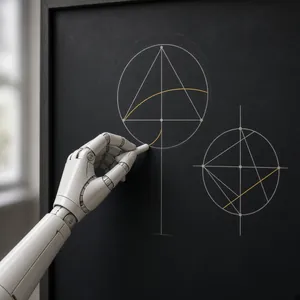
In maths, an OpenAI model in May disproved a geometry conjecture Paul Erdős set out in 1946. Nature said it was “cracked by an artificial-intelligence chatbot after a single prompt”. The mathematician Timothy Gowers, in commentary requested by OpenAI, wrote: “No previous AI-generated proof has come close”.
In medicine, the NHS in south-east England is rolling out AI skin-cancer checks “across 18 acute trusts from this autumn”. At Buckinghamshire Healthcare, “35% of patients assessed using DERM have been safely discharged with no further action needed”.
This is the abundance view. Peter Diamandis, whose weekly Moonshots podcast tracks technology, has made the case in his books. His website says they show “how technology is turning areas of scarcity into abundance”. The breakthroughs are real, and “slop” hides them.
The capability gap
Most people judge AI by the output from free AI models and their easily produced content, not by the best frontier AI models. Card data in a Harvard Business School working paper suggest only about 2.9% of US consumers paid for a major AI service in April 2026. Among US AI users, Menlo Ventures found 55% pay, so few pay only across the population as a whole. Frontier models, the most capable systems from the leading labs, are on a different level.
Their builders make bold forecasts, and have a commercial stake in the answer. In September, OpenAI’s Sam Altman said that a year earlier he had not expected a short path to superintelligence: “Now I think it may happen. I’m not confident it’s going to happen.” In June, Anthropic’s Dario Amodei wrote that a year or two more of scaling would likely bring “a country of geniuses in a datacenter”. Elon Musk claims Tesla will make 20,000 Optimus robots a week by the end of 2027.
Frontier models, the most capable systems from the leading labs, are on a different level.
These are forecasts, and some have already slipped. But an outside measure points the same way. On data from the research group METR, the length of task AI agents can complete has doubled about every 129 days since 2023. METR stopped updating its measure in September 2026, and its tasks are mostly software. If your picture of AI comes from a meme generator, it is already out of date.
The next two years
If you think AI models are slop, you are in for a big surprise over the next two years.
Many people will feel it first at work, especially in knowledge work. A UK government assessment in January 2026, citing IMF estimates, said around 70% of UK workers are in jobs with tasks that AI could perform or enhance.
The Office for National Statistics found that 30% of UK businesses used at least one AI technology in September 2026. For businesses with 250 or more staff it was 51%, up from 19% in 2023. So far, 6% of AI-using firms with 10 or more staff say AI has cut their headcount.
In October, Barclays said it expects to cut about 5,000 jobs as part of a modernisation plan. Its finance chief said around 60% of the changes are in support functions, “including fewer developers as AI makes our people more productive”. As the BBC noted, “not all of the cuts are due to AI”.
Dismissing AI and automation as a joke will not slow this transformation down.
That does not mean every job disappears. There are always new jobs that appear with new technology. Dismissing AI and automation as a joke will not slow this transformation down. It will just leave people unprepared for what is to come.
Then come the robots

On 21 October Tesla said it had started production of its Optimus humanoid robot in Fremont, California, on a line that built Model S and Model X cars until earlier this year. Musk calls it “early production”.
Today the clips that go viral are the pratfalls. Yet at the second World Humanoid Robot Games in Beijing in August, a robot called Tiangong Ultra ran 100 metres in 8.64 seconds.
But balance and handling unfamiliar objects are among the hardest problems in engineering, and the progress is real.
But balance and handling unfamiliar objects are among the hardest problems in engineering, and the progress is real. Figure says pretraining lifted its Helix 2.5 robot’s success at chores in homes it had never seen from 9% to 56%. Google DeepMind says Gemini Robotics 2 can control “full humanoids, from feet to fingertips”, though it admits “multi-finger dexterous manipulation remains challenging”. These are company claims, but the pratfall is the early draft, not the final product.
A new mindset is required
The AI and automation revolution is likely to cause significant disruption in the world economy. It will transform everything from how we work to how we run public services. Some of that will hurt, and the people who bear it deserve honesty and support.
But the gains could be enormous, and some are already visible. In Bradford, AI skin checks mean “32 patients can be seen in each session, compared to 24 before”. In September Insilico Medicine began what it calls the first Phase III trial of a drug found with generative AI. On farms, John Deere says customers using its camera-guided See & Spray system are “achieving more than 50% herbicide savings”. In factories, a Rockwell Automation plant in Singapore reports that AI and other digital tools “increased units per person-hour by 43%”. Deere and Rockwell report their own figures. The head of the Bank for International Settlements says task-level studies show generative AI delivering “productivity gains of between 10 and 65%”. Together they point to earlier diagnosis, new medicines, cleaner farming, more productive factories and more time for the work only people can do. They depend on choices made now.
Wales is not starting from nothing. A May 2025 ONS survey, cited in the AI Plan for Wales, found that just under half of responding Welsh businesses (49%) were not using AI, slightly lower than the 56% across the UK. That is a base to build on, but it still leaves almost half on the sidelines.
So we need to treat AI as a serious tool, not a punchline or an easy insult. Public services can implement AI and automation with proper safeguards and make huge savings and productivity gains, but must support staff during the transition. Private sector businesses can completely transform their models and processes. Employees can be given the skills to move into better work.
So we need to treat AI as a serious tool, not a punchline or an easy insult.
The “AI is slop” mindset feels safe, because it lets us laugh at this daunting technology and dismiss it as another tech bubble ready to pop. A more productive mindset is to be curious and prepared. Call out the junk, then look past it, because what sits behind it will shape the next decade in Wales.